
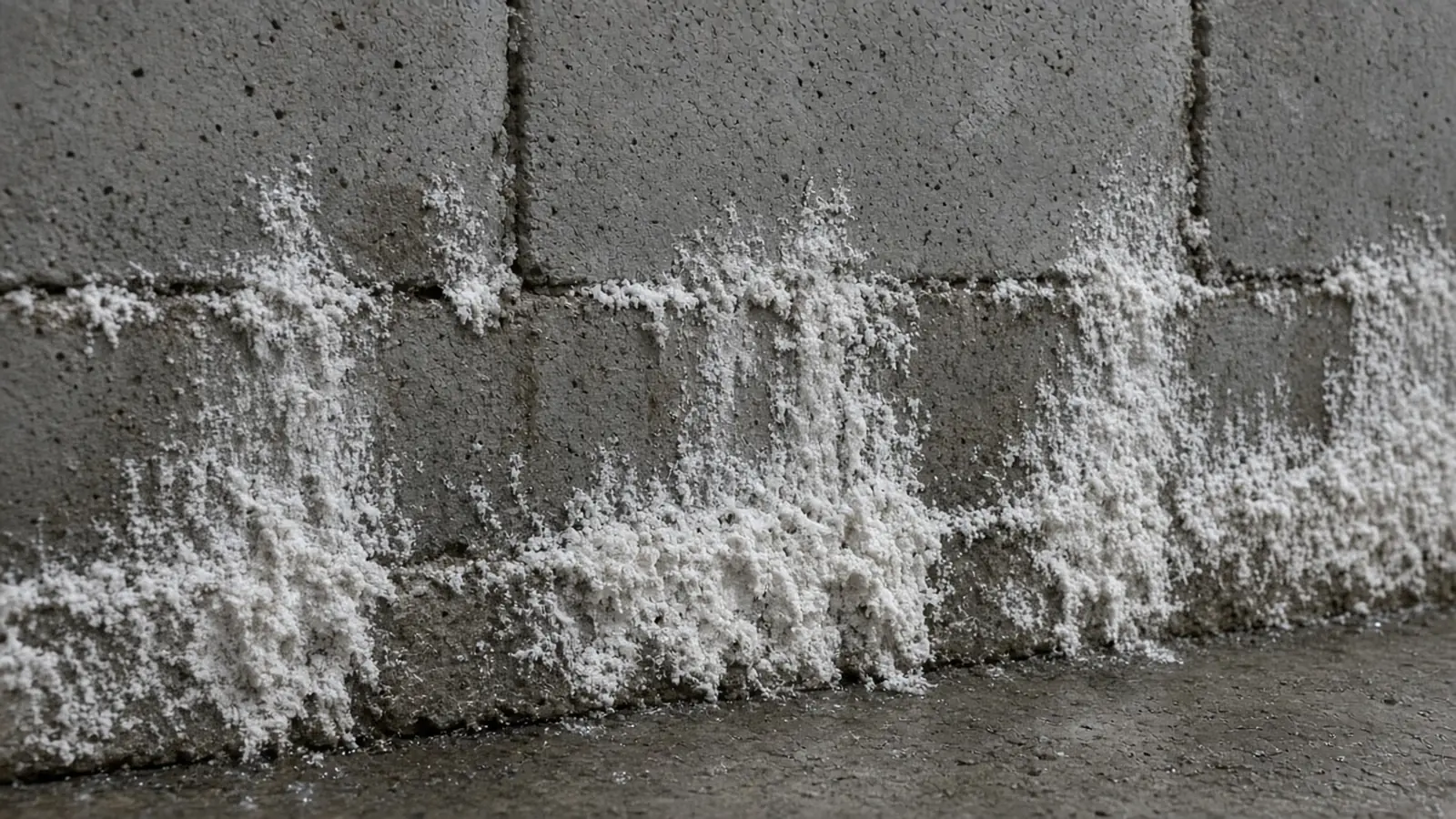
The white, chalky or crusty powder on many Rochester basement walls is usually efflorescence: mineral salts left behind when water moves through concrete, block, brick or stone and evaporates on the inside surface. It is not dangerous on its own, but it tells you water is getting into the wall, and that is worth understanding.
How efflorescence forms
Concrete, mortar and masonry contain soluble salts. When groundwater soaks into a foundation wall from the outside, it dissolves some of those salts and carries them through. On the inside face, the water evaporates into the basement air and the salts stay behind as white deposits. The more water moves through, the heavier the buildup.
That is why efflorescence tends to appear:
- Along the bottom few courses of block walls, where water pressure is highest.
- Along mortar joints, which are more porous than the block or stone.
- Around cracks that let water through.
- After the spring thaw, when the soil around Rochester foundations is wettest.
Efflorescence or mold?
They can look similar at a glance. A few simple checks help:
- Texture. Efflorescence is crystalline or powdery and crumbles when touched. Mold is usually fuzzy or slimy and may be green, black or white.
- Surface. Efflorescence grows on masonry. Mold prefers organic material such as wood, paper, cardboard, drywall and dust.
- Water test. A drop of water dissolves efflorescence; mold does not dissolve.
- Vinegar test. Efflorescence fizzes slightly with vinegar on masonry.
If you see fuzzy growth on wood framing, stored boxes or drywall, that is a separate problem. The EPA's mold guidance explains cleanup and when to call a professional.
What it says about your basement
A light dusting on an old stone wall in a city home near Highland Park may be a normal part of how that foundation has always behaved. Heavy, recurring buildup on a block wall, especially with a damp band at the floor line, usually means water pressure against the wall during wet seasons. If you also see peeling paint, rust at the base of appliances or puddles, the wall is taking on enough water to deal with.
Why it can look worse in some seasons
Many homeowners notice the white crust most in late spring and early summer. That timing makes sense. Through March and April, melting snow and spring rain push water into the wall. As the soil dries and the basement warms, that water keeps moving inward and evaporating at the surface, leaving fresh salt behind. In a dry fall, the deposits may stop growing, only to return after the next thaw.
Heat and airflow matter too. Walls near a furnace, a dryer vent or a dehumidifier often dry faster and show heavier deposits, while a cold corner behind stored boxes may stay damp with little visible salt. A wall with no powder at all is not automatically dry, so look for damp bands, musty smells and peeling paint as well.
What to do
- Clean it dry with a stiff brush and vacuum.
- Fix outside water: downspouts, gutters and grading. See downspouts and grading for a drier basement.
- Watch it through the next spring. Note where it returns.
- Address the water. For seepage at the base of block walls, an interior perimeter drain with weep holes is a common fix. For a leaking crack, crack injection. For persistent humidity, a dehumidifier.
Avoid painting over efflorescence with waterproofing paint. Salt and water pressure lift coatings off. Stone foundations need extra care; see waterproofing an old fieldstone foundation.
Questions homeowners ask
Is efflorescence harmful?
Efflorescence itself is just mineral salt and is not toxic. It is a sign that water is moving through the wall and evaporating on the inside. Over time, that water and the salt crystals can wear away mortar and the surface of block, brick and stone.
How do I clean efflorescence off a basement wall?
Dry-brush it with a stiff brush and vacuum the dust. Avoid soaking the wall with water, which just dissolves more salt. Cleaning only treats the symptom; if the water source is not fixed, the deposits come back after the next wet season.