
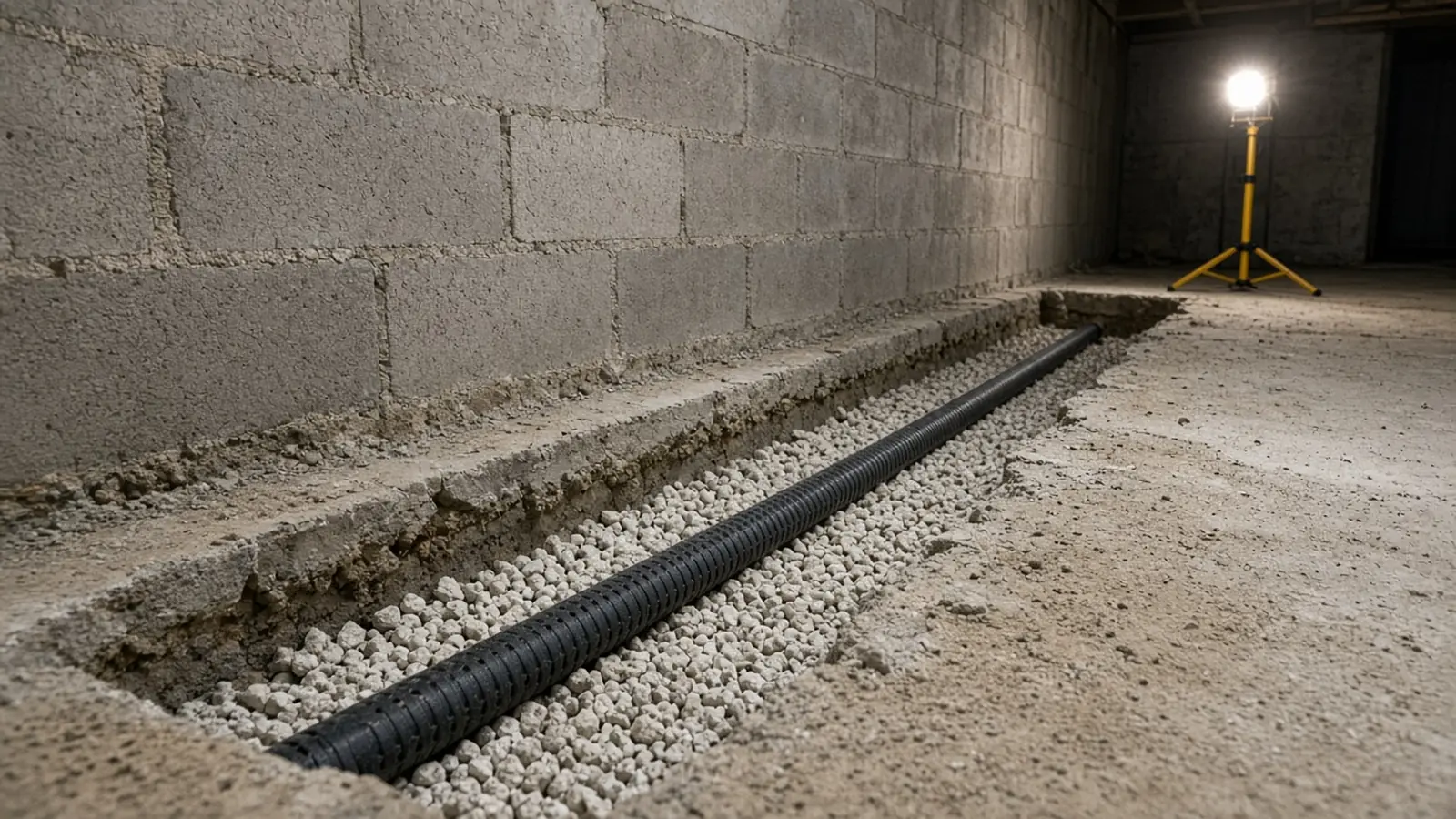
An interior French drain in Rochester, NY is a perforated pipe set in stone in a trench cut along the inside edge of your basement floor. It collects water that leaks through the walls or rises at the cove joint and carries it to a sump pump, which pushes it outside. Call our referral line (number coming soon) and we connect you with an independent local contractor that installs interior drainage in your town.
How does an interior perimeter drain work?
Most basement leaks in Monroe County are not holes. They are pressure. When the soil around your foundation fills with water after a thaw or a long rain, that water pushes against the walls and up under the slab. It finds the easiest path in, which is usually the joint where the wall meets the floor, the hollow cores of a block wall, or cracks in a poured wall.
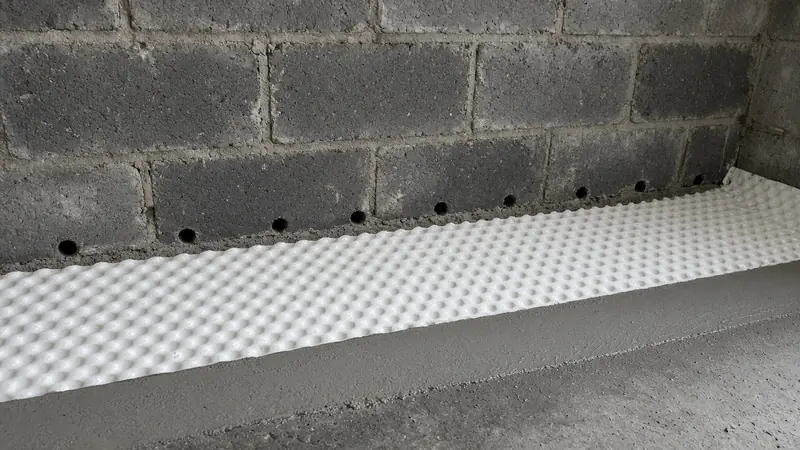
An interior drain gives that water an easier path. The installer removes a strip of floor about a foot wide around the perimeter, digs down near the footing, lays perforated pipe in clean stone and pours new concrete over it. On block walls, small weep holes are often drilled into the bottom course so water trapped in the cores drains straight into the trench. A plastic dimple membrane on the lower wall directs seepage down behind it, out of sight, and into the system. All of it slopes to a sump basin.
Why are interior drains so common in Rochester?
Two reasons: the weather and the foundations. Rochester averages roughly 102 inches of snow a season, and March and April are when that snowpack melts into soil that is still partly frozen. Neighborhoods on the lower ground near the Genesee River and the old Erie Canal corridor can see groundwater sit high for weeks. The New York State Canal Corporation still drains and refills the canal each year, and homeowners near low spots notice how wet the ground stays.
Then there are the houses. In neighborhoods like the South Wedge, Corn Hill and the streets around Highland Park, many basements have stone or early block walls. Digging out the outside of those walls is expensive and sometimes impractical between closely spaced houses and driveways. An interior system can be installed from inside, in any season, without tearing up landscaping or a neighbor's side yard.
What happens during an installation?
- Inspection. The contractor walks the basement, checks where water enters, looks at the wall type and finds the best spot for the sump.
- Prep. Storage is moved away from the walls and the area is protected from dust.
- Trenching. The floor is cut and removed along the walls that need drainage, sometimes the full perimeter and sometimes only one or two walls.
- Drain and stone. Perforated pipe is laid in washed stone with the right slope toward the sump.
- Wall drainage. Weep holes and a wall membrane are added where needed.
- Sump and discharge. A sealed basin and pump are installed and piped outside, away from the foundation.
- Concrete. The trench is closed with new concrete and the area is cleaned up.
The discharge matters as much as the drain. Monroe County's sewer use law does not allow groundwater from sump pumps and foundation drains to go into the sanitary sewer without permission, so the water has to go to the yard, a dry well or a storm connection where the town allows it. Our sump pump installation and repair page covers pumps, backups and frozen discharge lines in more detail.
When is an interior drain the wrong answer?
An interior drain handles water at the floor line very well. It is not the answer for every problem:
- A wall that is bowing or has a long horizontal crack needs structural attention first. See bowing basement wall repair.
- A single leaking crack in a poured wall can often be injected for much less. See foundation crack repair.
- Water coming over the top from a low window well, a bad grade or a short downspout needs an outside fix.
- Humidity without liquid water is a dehumidification and air-sealing problem, not a drainage one.
A good contractor will tell you when a smaller fix will do. If two quotes recommend very different systems, ask each one to explain where they think the water is coming from.
Questions to ask before you hire
Ask which walls the drain will cover and why, where the sump will go, where the discharge will exit, how they handle a frozen discharge line in January, and whether the price includes concrete, membrane, weep holes and cleanup. Ask what the warranty covers, whether it transfers if you sell, and whether the job needs a permit in your town. Get it all in writing.
Homeowners in Greece and Irondequoit, where lake-area soils stay wet, ask about interior drains more than almost anything else. For a side-by-side look at the two main approaches, read interior vs. exterior waterproofing for Rochester homes.
Questions homeowners ask
How long does an interior French drain installation take?
For a typical Rochester basement, the work itself usually takes a few days. The crew moves storage away from the walls, cuts and removes a strip of floor, digs the trench, sets pipe and stone, installs or connects the sump and pours new concrete. Large basements, stone foundations and tight access can add time.
Will an interior drain stop water coming through the walls?
It manages it rather than blocking it. Water that seeps through the wall runs down behind a membrane or drains from weep holes in the block into the trench, then to the sump. The floor stays dry even though the wall itself may still get damp in spring.
Does an interior drain work with a fieldstone foundation?
Yes, it is one of the more common approaches for old stone walls, because excavating and sealing the outside of a rubble foundation is difficult. Expect the contractor to talk about loose mortar, the footing, if any, and a membrane to direct wall seepage into the drain.
How is an interior French drain different from an exterior one?
An interior drain sits under the edge of the basement slab and catches water after it passes through the wall. An exterior footing drain sits outside the wall at the footing and catches water before it reaches the wall. Interior work avoids digging up the yard; exterior work keeps the wall itself drier.