
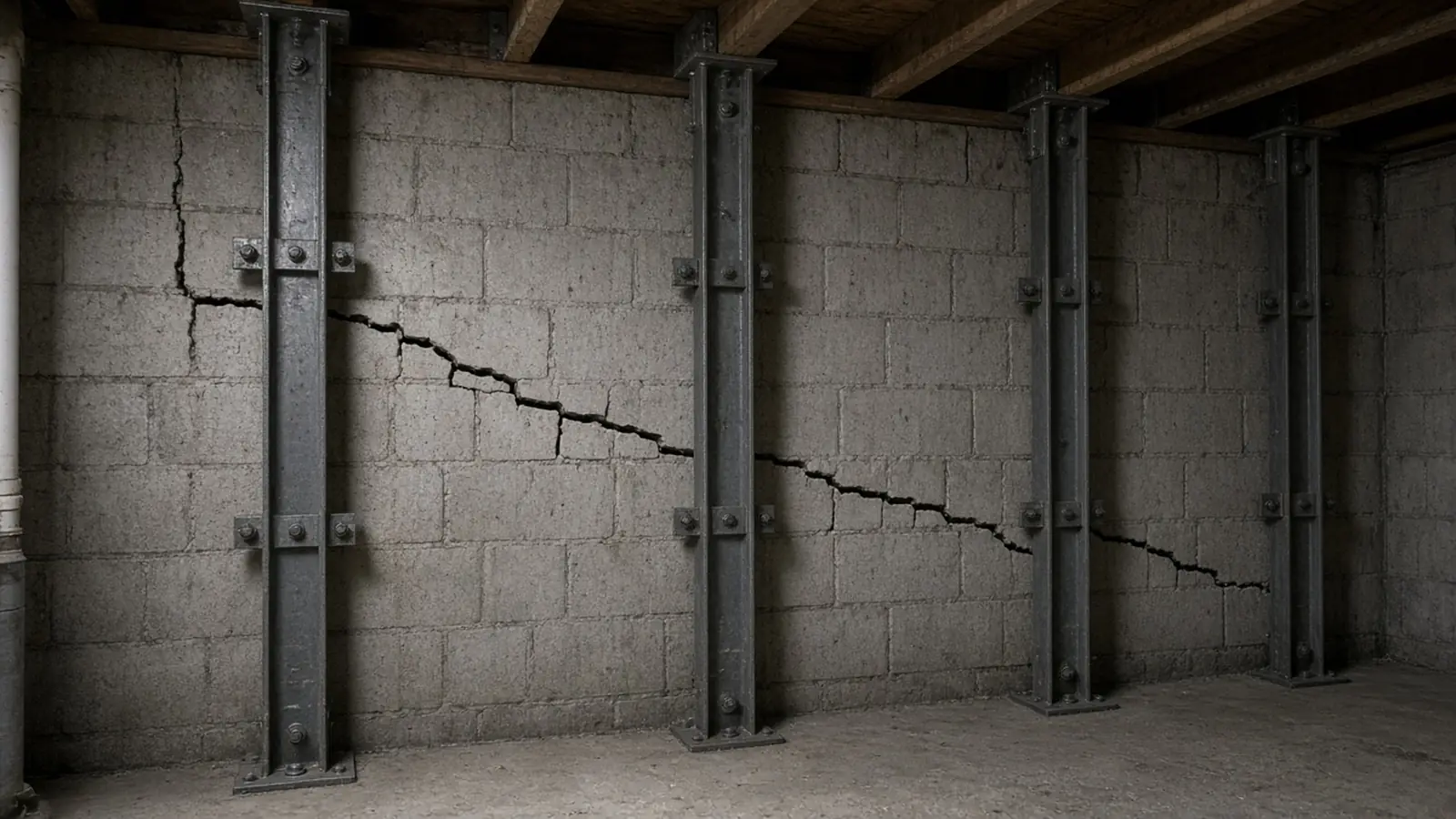
Bowing basement wall repair in Rochester, NY means stopping a block or poured wall that is being pushed inward by soil pressure, usually with steel wall braces, wall anchors or reinforcement, and reducing the water and frost pressure that caused it. Call our referral line (number coming soon) and we connect you with an independent local foundation contractor that stabilizes basement walls in your town.
Why do basement walls bow in Rochester?
Concrete block walls are strong when pressed from above but much weaker when pushed from the side. The soil outside pushes sideways all the time. In Monroe County, three things make that push stronger:
- Wet soil. Clay and silty soils hold water, and saturated soil weighs more and pushes harder. After the spring melt, the soil against many foundations is soaked for weeks.
- Frost. When wet soil freezes it expands. Rochester winters bring repeated freeze-thaw cycles, and each one can nudge a wall a little further.
- Water at the surface. Downspouts that empty right next to the wall, driveways that slope toward the house and snowbanks piled against the foundation all feed water into the soil right where it does the most damage.
Bowing is most common on block walls built in the middle decades of the last century, which describes a lot of homes in Irondequoit, Greece, Gates and the other inner-ring towns. It also shows up in older city neighborhoods near Cobbs Hill and along the slopes above the Genesee River gorge downstream of High Falls, where the ground drains downhill toward the foundation.
What are the repair options?
The right repair depends on how far the wall has moved, the wall type, access inside and out, and what an engineer recommends. Common options:
- Steel wall braces. Vertical steel beams set against the wall from floor to the joists above. They stop further inward movement and can be installed from inside without digging.
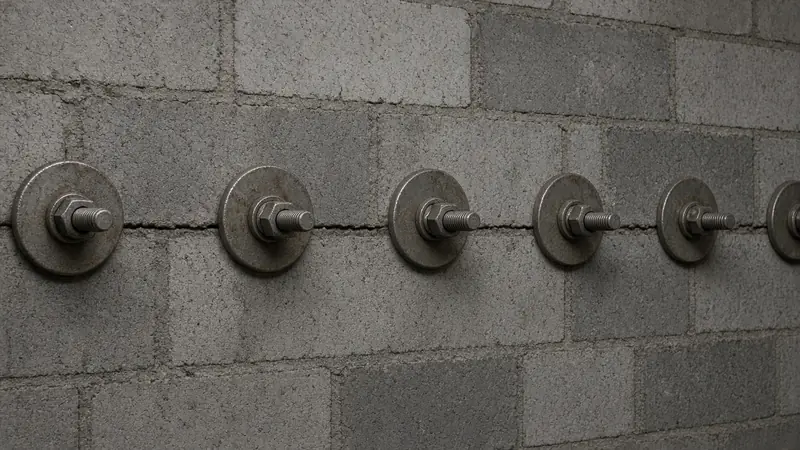
- Wall anchors. Steel plates on the inside connected by rods to anchors buried in the yard. They hold the wall and, in some cases, can be tightened over time to pull it back.
- Carbon fiber reinforcement. Strips bonded to the wall to resist further bowing on walls with limited movement.
- Excavate and rebuild. For walls that have moved a lot, the soil is dug out, the wall is straightened or rebuilt, and new drainage is added.
Most of these pair naturally with drainage work. Excavation is a chance to add a membrane and new footing drain through exterior foundation waterproofing. Inside, an interior drain and sump reduces the water pressure under the slab.
Permits and engineers
Structural repairs usually require a building permit. The City of Rochester lists structural repairs among the work that needs a permit, and each town in Monroe County runs its own building department. For many wall repairs, especially where movement is significant, an evaluation by a licensed professional engineer is worthwhile. The engineer works for you, not the contractor, and can specify what the repair needs to achieve. You can look up a New York engineer's license through the NYS Office of the Professions.
How urgent is it?
A fine, stable horizontal crack is something to monitor and plan for. A wall that is moving, a crack that is widening month to month, or a wall that has shifted at the bottom so it slides inward at the footing needs prompt attention. Mark the ends of the crack, measure the bow with a string line, photograph it with a date, and check again after a few weeks.
Callers from Irondequoit and Greece bring this up often, given how many mid-century block foundations those towns have. For why winters are so hard on walls, read freeze-thaw and foundation cracks in Rochester.
While you wait for an evaluation, keep the soil outside the bowed wall as dry as you can. Point downspouts away from that side of the house, keep snowbanks off it and avoid parking heavy equipment or vehicles close to the wall.
Questions homeowners ask
How do I know if my basement wall is bowing?
Look for a long horizontal crack in a block wall, often a few courses below the top or near the middle, stair-step cracks through the mortar at the corners, or a wall that leans or bulges inward when you sight along it. Hold a long straightedge or a taut string against the wall to check. Doors or windows above that start sticking can also be a sign.
Can a bowing wall be pushed back into place?
Sometimes, partially and slowly. Some anchor systems can be tightened over time to pull a wall back as the soil allows. Many repairs aim to stop further movement rather than straighten the wall. Badly displaced walls may need excavation and rebuilding. The right goal depends on how far the wall has moved.
Do I need an engineer for a bowing basement wall?
For significant movement, an engineer's evaluation is a good idea, and some building departments or lenders will want one. A structural engineer is independent of any contractor and can tell you what the repair must achieve. Ask whether a permit is needed in your town, since structural work generally requires one.
Will waterproofing fix a bowing wall?
Not by itself, but it helps. Bowing is caused by soil pressure, and wet, freezing soil pushes harder. Better drainage around the foundation, downspouts carried away from the wall and grading that sheds water reduce that pressure. Structural repair and drainage often go together.