
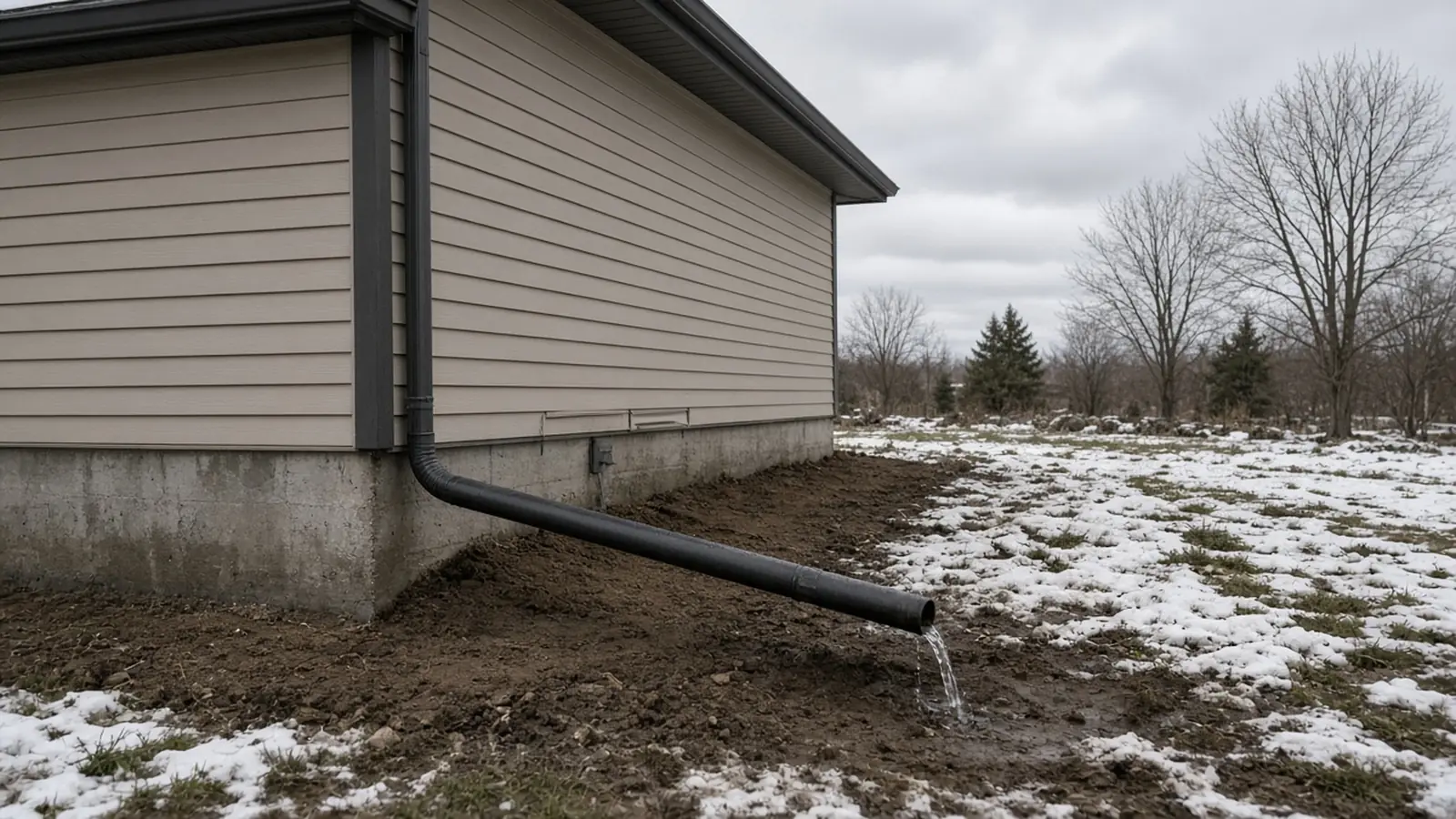
Before you pay for a drainage system, check the outside of your house. Short downspouts, soil that slopes toward the foundation, window wells without drains and snow piled against the walls cause many of the one-wall and one-corner leaks in Rochester basements, and they are usually inexpensive to fix.
Why roof water matters so much
A roof collects a remarkable amount of water. Every inch of rain on the roof becomes hundreds or thousands of gallons, all funneled through a few downspouts. If those downspouts empty at the base of the wall, they soak the backfill right where your basement is most vulnerable. In Rochester, the same thing happens during the thaw, when the roof's snow load melts and runs off for days.
Downspouts
- Extend them. Carry water several feet out, farther on flat lots. Flip-up or roll-out extensions work in summer; buried pipe works year-round.
- Bury and daylight. A solid pipe buried in the yard can carry water to a spot that slopes away. The outlet needs to stay clear of snow and ice.
- Do not tie into the sanitary sewer. Like sump water, roof water belongs outside or in a storm connection where allowed. See sump pump discharge rules in Monroe County.
- Clean gutters after leaves fall. Clogged gutters overflow at the eaves and dump water at the wall.
Grading
Over the years, backfill around a foundation settles. Soil that once sloped away can end up flat or sloping toward the house, especially in newer homes in towns like Henrietta and Webster and along older city streets near Genesee Valley Park, where decades of settling add up.
- Check the slope. Lay a long board on the ground against the house with a level on it. The ground should fall away.
- Add soil. Use a clay-rich or compactable soil near the house, not mulch or sand, and build up the grade so it slopes away.
- Keep beds below siding and sloped away. Edging that traps water in planting beds against the house makes leaks worse.
- Check hard surfaces. Patios, walks and driveways that slope toward the house may need repair or a drain.
Window wells
A well without a working drain fills with water like a bucket. Clean out leaves and silt, replace clogged gravel, make sure the well sits a few inches above the surrounding ground, and add a cover. If the well has a drain to the footing drain, flush it. See egress windows and window wells.
Snow
After a lake-effect storm, plow and shovel snow away from basement walls and window wells where you can. When banks against the house melt, the water goes straight down along the foundation.
When outside fixes are not enough
If you fix the outside and water still comes in at the floor line, especially around several walls, the problem is likely groundwater pressure, not surface water. That is when an interior drainage system or wet basement repair makes sense. For the spring pattern, see why Rochester basements leak during the spring thaw. For grading on new work, the New York State building codes are maintained by the Department of State.
Questions homeowners ask
How far should downspouts extend from the house?
A common guideline is several feet, more on flat lots or where soil drains slowly. The goal is to release roof water where the ground slopes away and it cannot run back to the foundation. Buried pipe that daylights at a lower point keeps extensions out of the way of mowers and snow blowers.
What slope should the ground have around my foundation?
Building codes generally call for the ground to fall away from the foundation for the first several feet, often about six inches over the first ten feet where space allows. On tight lots, swales or drains can do the same job. The key is that water moves away from the house, not toward it.